

Truth Lab Test #001

Mobile Link Bonding Comparison

A controlled Truth Lab evaluation examining what happens to real application traffic when one network path suddenly fails.

Disclaimer

Truth Lab results are based on controlled laboratory testing conducted by IP Access International using specific hardware, software versions, configurations, and network conditions at the time of testing. Results are intended to provide insight into relative system behavior under defined conditions and may not reflect performance in all real-world environments. Actual performance will vary based on network conditions, configurations, applications, and deployment scenarios. Truth Lab testing is informational in nature and does not constitute a performance guarantee.

Truth Lab Test #001

Executive Summary

Mission-critical connectivity isn’t defined by peak speeds or feature lists—it’s defined by how networks behave when conditions change unexpectedly.

To better understand real-world performance, IP Access International launched The Truth Lab, a controlled testing environment designed to evaluate connectivity technologies under repeatable, measurable conditions. The goal is simple: move beyond theoretical claims and observe how blended and bonded networks actually perform when stressed.

Core Question
What happens to real application traffic when one network path suddenly fails?

Using identical connectivity, default configurations, and controlled lab conditions, this evaluation compared how two widely deployed mobile link bonding platforms respond to link loss, recover traffic, and utilize available bandwidth. Rather than focusing on peak throughput—rarely achievable in mobile environments—the test emphasized efficiency, recovery behavior, background overhead, and application stability.

The results revealed meaningful differences in how each platform balances speed, efficiency, and operational trade-offs. In particular, the test highlighted the importance of default behavior, the hidden cost of background overhead, and how efficiently bandwidth is translated into usable application performance.

This evaluation does not declare a winner. Instead, it provides transparent insight into how different architectural approaches behave under stress—giving agencies and enterprises the data they need to make informed, mission-aware decisions.

Truth Lab Test #001 is the first in an ongoing series of independent evaluations focused on real-world connectivity behavior—not marketing promises.

Truth Lab Test #001

Mobile Link Bonding Comparison

What Happens When A Network Link Fails?

In critical operations, connectivity isn’t measured by peak speed alone—it’s measured by what keeps working when conditions change.

That’s why IP Access International launched The Truth Lab: a controlled testing environment designed to evaluate how connectivity technologies actually behave under stress. Not in theory. Not on spec sheets. But in measurable, repeatable scenarios.

Test Objective
What happens to real traffic when one network path suddenly fails?
Context & Importance

Why This Test Matters

Blended and bonded connectivity solutions are widely used across public safety, aviation, utilities, healthcare, and enterprise operations. These environments rely on multiple network paths—terrestrial fiber, cellular, and satellite—to maintain continuity.

But not all link bonding and blending technologies behave the same way when a path drops.

Some Prioritize Speed

🛡️

Some Prioritize Redundancy

📊

Few Are Evaluated On Real Impact

Few are evaluated on efficiency, recovery behavior, and real application impact—which is exactly what this test set out to measure.

Test Environment

Test Configuration & Methodology

To eliminate external variables, all testing was conducted entirely within the Truth Lab environment using controlled, repeatable conditions designed to produce measurable and unbiased results.

Minimal Internet traffic dependencies to reduce external fluctuations
Identical WAN connectivity delivered via Gigabit Ethernet
Same virtualization environment for hub-side reassembly
Default, documented settings only — no hidden tuning or advanced tweaks
Devices Tested
Dejero GateWay M6E6
Smart Blending Technology™
Peplink BR2 Pro 5G
SpeedFusion Technology

Testing conducted between December 1–8, 2025.

Truth #1

Overhead Is Not Free

Every link bonding solution introduces overhead—the background traffic required to maintain awareness across multiple paths.

What surprised us wasn’t that overhead exists—but how dramatically it can grow depending on how failure detection is handled.

What We Observed
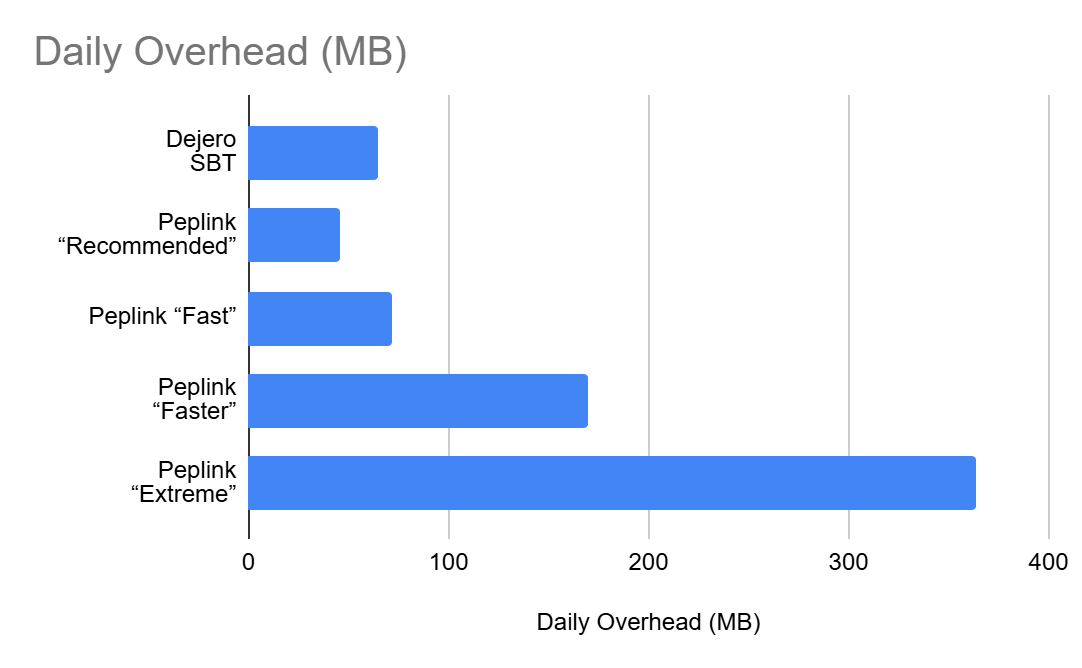
Peplink SpeedFusion enables faster link failure detection by increasing health-check frequency.
At its most aggressive (sub-second) detection setting, background overhead increased to approximately 364 MB per day.
Dejero Smart Blending achieved sub-second recovery without requiring increased health-check traffic or tuning, resulting in negligible background overhead by comparison.
Background Overhead Comparison
Why It Matters

Over time, overhead consumes data plans, reduces usable bandwidth, and increases operating costs—especially in satellite or other metered environments.

Fast recovery is critical—but fast recovery with minimal waste is even more important.

Truth #2

Blended Efficiency Beats Peak Speed

Initial testing with two unrestricted 1Gbps WAN links showed that neither platform could deliver a full 1Gbps of combined usable throughput.

That wasn’t a failure of the test—it was a reality check.

Rather than focus on unrealistic peak scenarios, we shifted testing to smaller, asymmetric, and constrained link speeds that more accurately represent real-world mobile environments such as cellular and satellite.
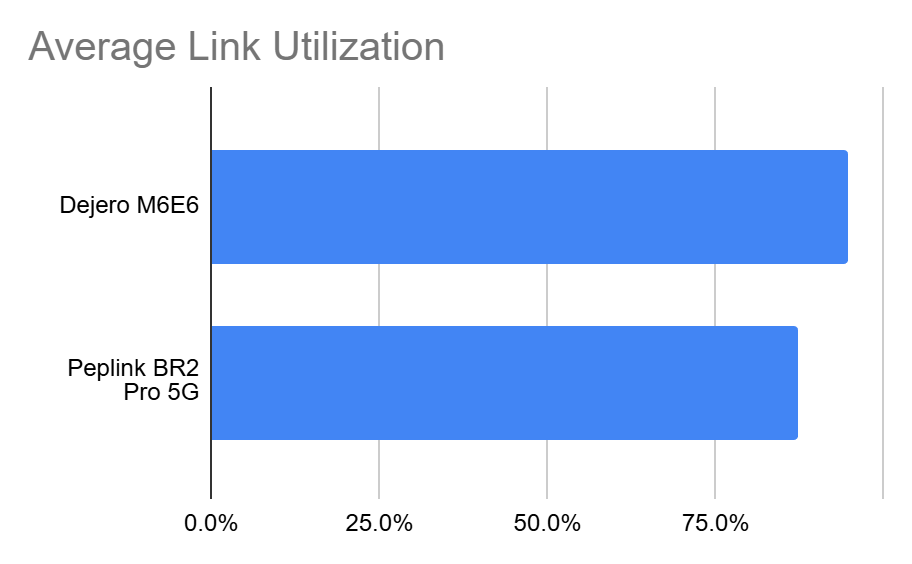
Average Link Utilization
Figure 3. Average Link Utilization.
The Results
94.83%
Available Capacity Utilized
Dejero Smart Blending
87.3%
Available Capacity Utilized
Peplink SpeedFusion
That difference represents real, usable bandwidth left on the table.
Why It Matters

In mobile operations, bandwidth is finite, expensive, and often shared.

Efficiency determines how much of what you pay for actually reaches your applications.

Truth #3

Default Settings Should Be Mission-Critical Safe

We then tested what happens when one WAN link fails completely—without pulling cables or triggering obvious “link down” events.

Default Behavior Results
Peplink (Default Settings)
Recovery interruptions of approximately 16–24 seconds.
Peplink (Extreme Detection Mode)
Achieved sub-second recovery through a one-time configuration change that increases health-check traffic.
Dejero (Default Settings)
Achieved sub-second recovery across all test methods without requiring adjustments or tuning.
Important Context

To be clear: Peplink's Extreme setting is a valid option and is easily enabled. However, it introduces a deliberate trade-off between faster recovery and increased overhead.

Why It Matters

Mission-critical environments benefit from solutions that behave predictably and safely out of the box, without requiring operators to decide between recovery speed and data efficiency.

Truth #4

Stability Is the Real Performance Metric

The Truth Lab intentionally used test methods that were highly sensitive to interruption, allowing us to observe how each platform behaved when continuity was challenged.

Test Methods Used
🔄
Persistent TCP Sessions
Continuous application traffic designed to expose session interruptions and recovery behavior.
📡
Rapid Ping Intervals
High-frequency monitoring intended to reveal even brief disruptions in connectivity.
Why We Chose These Tests

If connectivity survives these conditions, it will perform even better in real-world applications.

Real-World Applications
🚓
CAD Systems
🎥
Voice & Video
📊
Telemetry
☁️
Cloud Operations
Key Takeaway

Peak speed is easy to advertise. Stability under changing conditions is what keeps operations running. In mission-critical environments, uninterrupted application performance is often the metric that matters most.

Final Takeaway

What This Means for Real Operations

This test wasn’t about declaring a winner.

It was about validating how blended connectivity behaves under stress.

Efficiency Beats Speed

Efficient blending often delivers more real-world value than chasing theoretical peak throughput numbers.

🔄

Recovery Shouldn't Waste Data

Sub-second recovery is important, but achieving it with excessive background traffic creates long-term operational costs.

🛡️

Default Behavior Matters

Mission-critical environments benefit from platforms that behave predictably and safely without requiring extensive tuning.

The Truth Lab Conclusion

The most effective connectivity solutions aren't defined by the highest speed test result. They're defined by how consistently they maintain application performance when networks become imperfect.

About The Truth Lab

Why The Truth Lab Exists

IP Access International works across multiple connectivity technologies—LTE, LEO, GEO, private wireless, and SD-WAN. We believe customers deserve validated answers, not marketing claims.

🧪

Test Before Deployment

Validate technologies before they impact critical operations in the field.

Validate Assumptions

Challenge conventional thinking and verify performance through measurable testing.

🔍

Provide Transparency

Share objective findings that reveal how networks actually behave.

Coming Next

Degraded & Dynamic Connectivity Testing

Our next Truth Lab evaluation will examine these same platforms in degraded and rapidly changing connectivity environments—including in-motion scenarios and disaster conditions where networks fluctuate constantly.

Truth Lab Test #001 Complete

This was Truth Lab Test #001—and it's just the beginning.

More results coming soon.

Truth Lab Submission

Suggest a Test

Have a connectivity challenge, technology comparison, or real-world scenario you'd like us to evaluate? Submit your idea below. The Truth Lab exists to test claims, validate performance, and uncover what actually happens under real operational conditions.

Tell us what challenges you’re facing or what performance questions you need answered. Our team will review and determine where it fits within our testing roadmap.
=

Disclaimer: By providing my contact information, I acknowledge and give my explicit consent to be contacted via SMS and receive emails for various purposes, which may include marketing and promotional content. Message and data rates may apply. Message frequency may vary. Reply STOP to opt out. Refer to our Privacy Policy for more information.