
Keep the radio, extend the reach: lessons from the MACC911 field test
Four radio systems across three states. Voice traffic that stayed connected as individual network paths were removed. A vehicle gateway that extended portable radio communications beyond traditional coverage.
Explore what the MACC911 demonstration showed—and what agencies should evaluate before making their next communications investment.
What if the radio on a responder’s belt could reach farther?
In August 2026, the Multi Agency Communications Center (MACC911) in Grant County, Washington, hosted more than 60 public safety professionals for a field demonstration. The exercise examined how existing radio systems could connect through broadband, how those connections performed when individual network paths were removed, and how vehicle gateways could extend portable radio coverage.
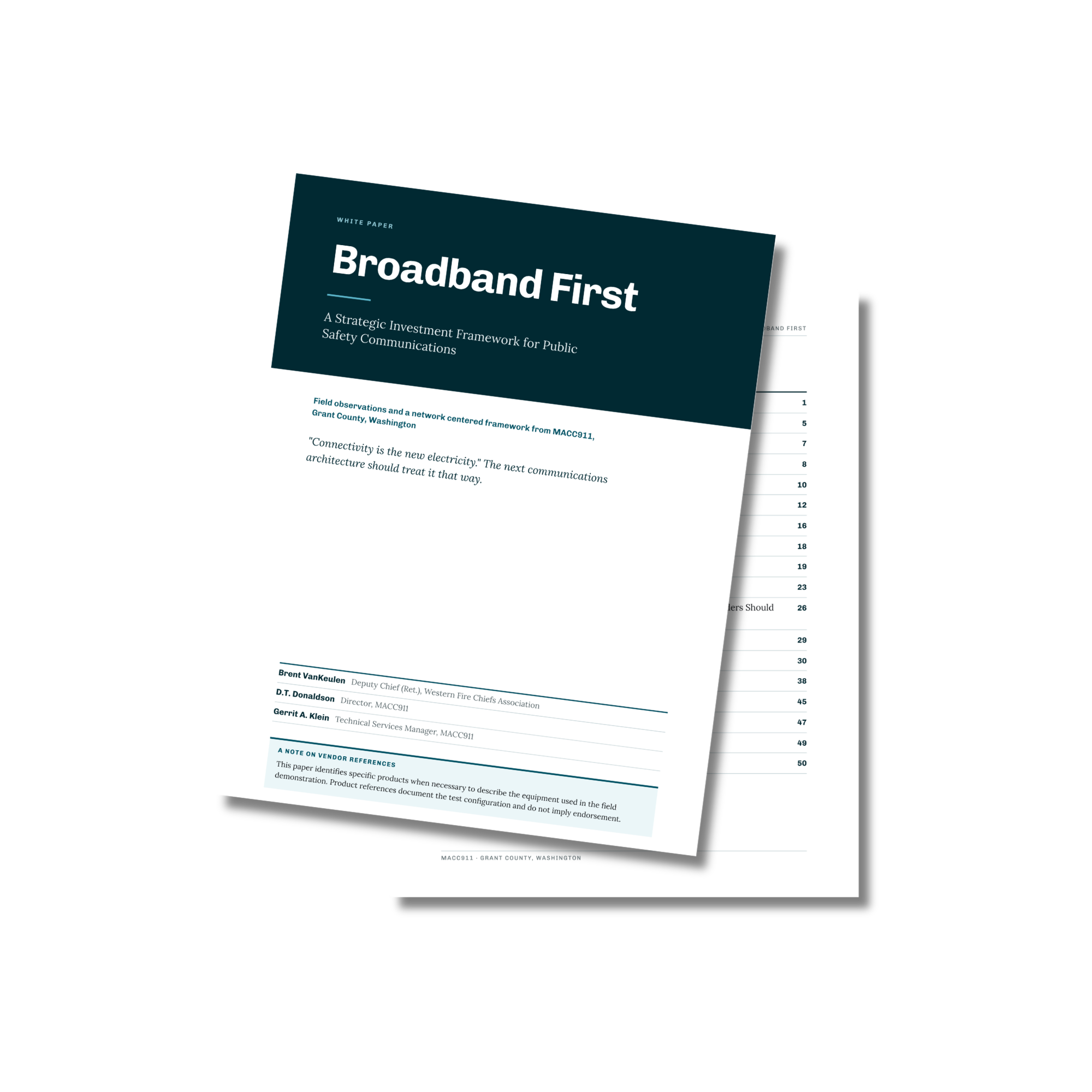
The resulting white paper, Broadband First: A Strategic Investment Framework for Public Safety Communications , explores a broader role for resilient connectivity. LMR remains essential for immediate shared tactical voice, while broadband provides a common layer for interoperability, data, and other operational applications.
Keep mission-critical LMR healthy. Build resilient broadband alongside it. Let demonstrated operational needs guide the next investment.
What the demonstration showed
These observations are reported in the supplied white paper. They describe the tested configurations and conditions.
Four systems shared one talkgroup
MACC911, LA County RICS, New Mexico State Police, and Spokane operated on a common talkgroup. Spokane and New Mexico each joined in approximately 10 to 15 minutes without a previous connection to MACC911.
In the documented exchange between Grant County and LA County, responders used their normal portable radios without reprogramming either radio.
A transmission remained connected
A continuous radio transmission remained connected as Verizon, FirstNet, AT&T, T-Mobile, and Starlink paths were removed one at a time.
The observation demonstrated continuity during that sequence through the remaining available paths.
Local radio connected to a wider network
A deputy maintained voice communications from a jail area without usable cellular service or access to the trunked radio system by connecting through a vehicle gateway.
In a separate wildland range test, portable radio communications reached approximately 4.7 miles from the vehicle.
The 4.7-mile result is an observation, not a coverage guarantee. Terrain, antenna placement, radio band, power, obstructions, and interference affect usable range.
The vehicle becomes a communications node
In the tested configuration, a portable radio communicated locally with an EF Johnson VM8000 mobile radio operating as a gateway. The gateway bridged that radio traffic onto broadband, connecting it to dispatch and participating systems.
The local radio link and the broadband connection performed different jobs. Together, they enabled communications beyond the portable’s direct access to the trunked system.
A connected vehicle can also support CAD, location information, messaging, video, and other applications. That gives agencies a reason to evaluate connectivity as shared operational infrastructure.
Multiple paths support the same mission
Dejero GateWay devices and Smart Blending Technology provided the blended transport used in the demonstration. IP Access International contributed systems integration, managed cellular and LEO satellite connectivity, field services, and support.
Real-time blending uses available network paths together, reducing dependence on any single connection. The path-removal exercise demonstrated the benefit under the tested conditions.
Resilience also depends on network diversity. Agencies should evaluate shared fiber routes, power sources, carrier infrastructure, satellite availability, and application dependencies when designing the broader system.
Explore IP Access public safety connectivity solutions for facilities, vehicles, and field operations.
The open questions belong in the evaluation
The MACC911 exercise was a field demonstration, not a controlled or longitudinal study. Alongside the successful connections, the team documented issues that require further testing:
- Intermittent audio loss in some configurations.
- Differences in emergency-button behavior among systems.
- Restrictions on mobile-radio transmission while certain gateway configurations were active.
A gateway connection also requires evaluation of identity, encryption, console behavior, recording, and governance. Passing voice traffic does not establish that every function behaves the same way across interconnected systems.
The operational test should reach all the way to the responder: can they communicate quickly, predictably, and with minimal effort while performing their job?
Let a focused pilot guide the next investment
The white paper describes an initial pilot using a radio the agency already owns, a gateway, and a commercial push-to-talk application, with a planning estimate of under $5,000. Actual costs, configurations, and purchasing requirements will vary.
Start with an operational requirement: a coverage gap, a mutual-aid connection, or a need to maintain communications when one network path becomes unavailable. Test that requirement with dispatchers and field personnel before expanding.
- Measure voice quality and coverage in the environments responders actually use.
- Verify emergency signaling, security, recording, and dispatcher workflows.
- Remove individual network paths and document how the system behaves.
- Evaluate training needs, support, recurring services, and lifecycle costs.
When a larger investment approaches, compare fixed radio infrastructure, vehicle broadband, gateways, and targeted coverage solutions against the same requirements. Some needs will favor a tower. Others may be served through a combination of technologies.
The MACC911 findings provide a starting point for that evaluation. Each agency’s own testing should determine what earns the next investment.
What should agencies take from the test?
Does this approach replace an agency’s LMR system?
The white paper recommends maintaining mission-critical LMR while building a resilient broadband layer alongside it. Agencies can then evaluate where gateways and broadband improve coverage, interoperability, and application access.
Does every deployment achieve 4.7 miles of portable radio range?
No. Approximately 4.7 miles was observed in one wildland range test. Each agency must validate coverage with its own equipment, antennas, terrain, and operating conditions.
Where are the detailed findings and limitations documented?
Appendix A of the white paper documents the field test and open questions. Appendix B presents a phased investment framework, planning estimates, and a procurement checklist.
Read the findings. Define your next test.
Download the MACC911 white paper for the documented results and investment framework. To discuss how blended connectivity and radio integration could support your agency’s requirements, connect with IP Access International.