
Mission-Critical Connectivity for Public Safety: The Complete Guide
A practical guide to the cellular, LEO satellite, connected-vehicle, portable and managed network technologies helping public safety agencies keep personnel, applications and field operations connected.
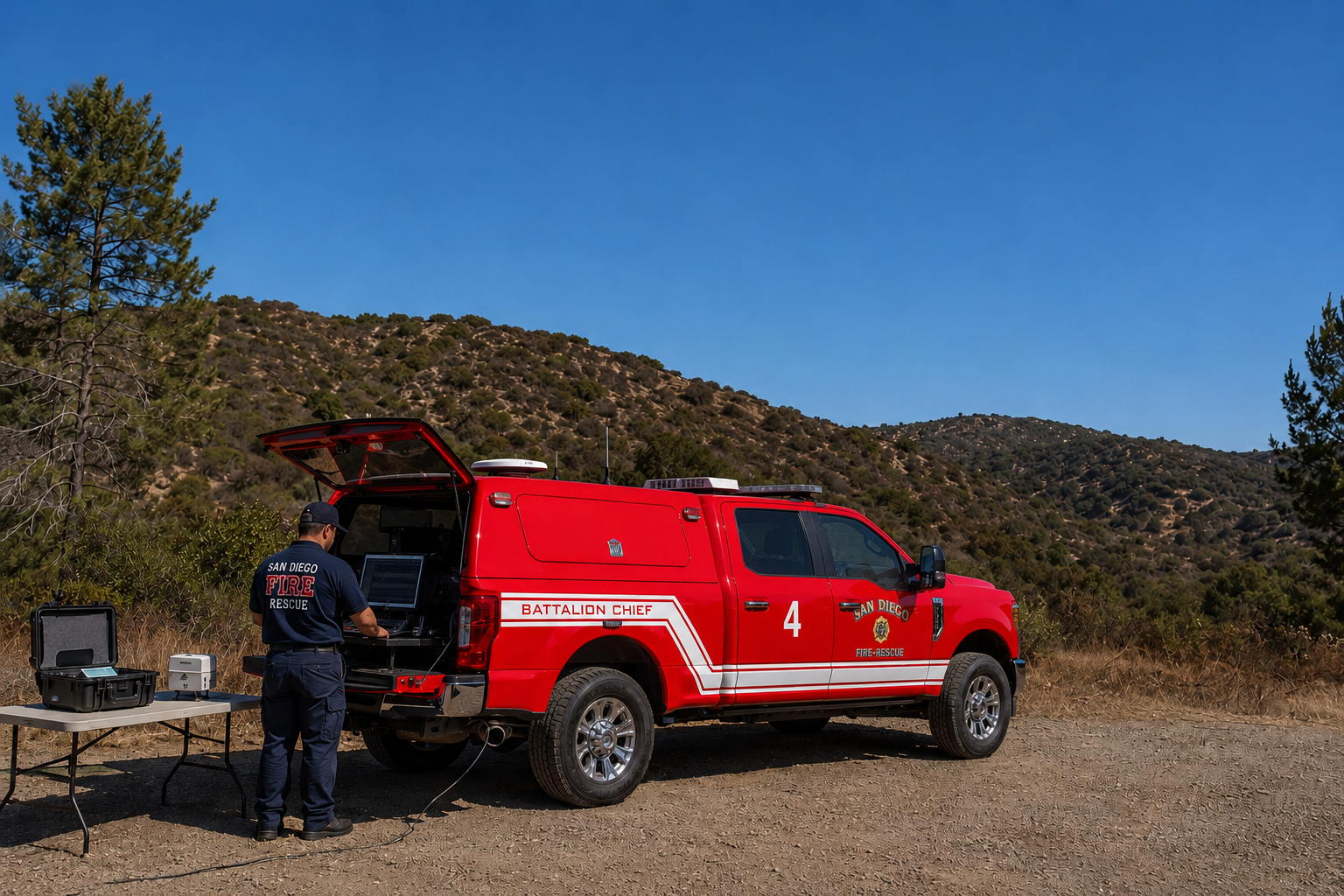
Public safety operations have become increasingly dependent on connectivity. Police officers access CAD and mapping from vehicles. Fire personnel receive incident information while responding. EMS teams use connected applications in ambulances. Emergency managers coordinate resources from mobile command units. Field teams transmit video, access cloud platforms and share situational awareness from locations far beyond the communications center.
The applications have changed. The vehicles have changed. The amount of data moving between the field and the agency has changed. And the communications networks supporting those operations are changing with them.
Mission-critical connectivity is the communications environment that allows personnel, vehicles, devices and applications to exchange information during operations where loss of connectivity can significantly affect the mission.
Public Safety Has Become a Connected Operation
Public safety communications were once dominated primarily by voice. Voice remains essential, particularly land mobile radio, but modern operations also depend on an expanding ecosystem of IP-based applications.
Officers, firefighters, paramedics, dispatchers and emergency managers may rely on connectivity for CAD, AVL, mapping, situational awareness, records access, video, messaging, telemedicine, cloud applications and mobile command operations.
Many of these applications are accessed from the field rather than a fixed facility. That means the communications network increasingly has to travel with the responder.
Connected Vehicles
Patrol vehicles, ambulances, fire apparatus and command units increasingly operate as mobile network environments supporting multiple users, devices and applications.
Connected Field Teams
Responders increasingly need access to agency systems, mapping, video and cloud applications outside the communications center.
Connected Command
Incident command and emergency management operations depend on dependable access to information as incidents move or expand.
Connected Applications
The operational value of connectivity is measured by whether critical applications remain usable, not simply whether a modem displays an active connection.
Why One Network Is Rarely Enough
Every communications network has strengths. Every network also has limitations.
Cellular networks provide broad coverage and strong performance across much of the country, but carrier performance varies by geography and congestion. Satellite networks can extend broadband beyond terrestrial infrastructure, but they have their own deployment and environmental requirements. Wired networks provide tremendous capacity to fixed facilities but cannot follow field teams.
Network diversity creates more than one potential path between personnel, vehicles, applications and agency systems.
A public safety vehicle may have excellent cellular performance in one part of a jurisdiction, experience a different carrier performing better a few miles away, and later enter an area where terrestrial coverage becomes limited and a satellite connection adds valuable reach.
Moving Beyond the Backup-Network Mindset
Public safety connectivity has historically been described in terms of primary and backup networks. The primary connection carries traffic until it stops working, then the backup takes over.
Modern connectivity requires a more nuanced view because networks do not always transition cleanly from working to not working.
- High latency can affect application performance.
- Congestion can reduce available bandwidth.
- Packet loss can interfere with real-time applications.
- A weak connection may remain technically active while becoming operationally unusable.
For critical applications, the better approach is to evaluate the quality of the available connectivity rather than simply whether a network is technically online.
Cellular Connectivity for Public Safety
LTE and 5G remain foundational technologies for mobile public safety connectivity. They offer broad coverage, high performance and a mature ecosystem of vehicle routers, modems and connected devices.
Agencies may have access to multiple commercial cellular networks. Because carrier coverage and capacity vary by location, using more than one carrier can increase available connectivity options across a jurisdiction.
Cellular is still terrestrial, however. Rural geography, mountains, infrastructure outages and local network congestion can create environments where another path becomes valuable.
Learn more about mobile connectivity solutions for public safety vehicles.
LEO Satellite Connectivity
Low Earth orbit satellite networks have changed what satellite broadband can look like in public safety.
LEO satellite connectivity can provide broadband access beyond the reach of nearby terrestrial infrastructure and can support mobile, portable and fixed deployments depending on the selected network, hardware and operating environment.
Agencies are evaluating LEO satellite for emergency vehicles, mobile command units, emergency operations, disaster response, remote facilities, search-and-rescue missions and portable field kits.
LEO Satellite for Public Safety and Government
Explore how LEO satellite connectivity fits into public safety, emergency response and government operations, including California agency deployments and statewide procurement options.
Starlink for Public Safety
Starlink has accelerated interest in satellite broadband across public safety because compact, rapidly deployable hardware can extend broadband access into vehicles, field operations and temporary command locations.
Agencies are evaluating Starlink for police vehicles, ambulances, fire apparatus, command vehicles, emergency management assets and portable field deployments.
But purchasing the hardware is only the beginning. Larger deployments also require planning around service, data, installation, power, hardware management, network integration, support and fleet-wide administration.
IP Access International is an Authorized Starlink Reseller and can provide Starlink hardware, managed service, installation and 24/7/365 U.S.-based network support.
Starlink for First Responders
Explore how first responders can use Starlink for emergency vehicles, incident command, disaster response and field operations.
Eutelsat OneWeb and Additional LEO Options
Eutelsat OneWeb provides another Low Earth orbit satellite network option for organizations that need broadband connectivity beyond traditional terrestrial infrastructure.
Different LEO networks use different hardware, architectures and service models. That gives agencies additional flexibility when designing satellite connectivity around mission requirements.
IP Access is an Authorized Eutelsat OneWeb Distribution Partner and can help agencies evaluate which available network options make sense for a particular deployment.
The Connected Public Safety Vehicle
One of the most significant changes in public safety communications is happening inside the vehicle.
Police cars, ambulances, fire apparatus, command vehicles and emergency management vehicles increasingly operate as mobile network environments.
- Mobile data computers
- Tablets
- Cameras
- Vehicle routers
- Cellular modems
- Satellite terminals
- Wi-Fi
- IoT devices
- Communications gateways
Instead of treating every device as an independent connection, agencies can begin thinking about the vehicle itself as a connectivity platform.
Creating a Connectivity Bubble
A properly designed connected vehicle can create a local communications environment around the asset.
Authorized personnel nearby can connect laptops, tablets, phones and other devices to the vehicle's network, allowing the vehicle to become a communications hub for the team.
This creates what IP Access describes as a connectivity bubble around the vehicle.
Explore connected public safety vehicle solutions from IP Access.
Mobile Command Units
Mobile command units may be one of the clearest examples of mission-critical connectivity in practice.
These vehicles bring personnel, applications and decision-making closer to an incident. Teams inside may simultaneously access CAD, GIS, video, situational awareness, weather information, cloud applications and incident documentation.
A command vehicle may deploy to a location with excellent terrestrial connectivity one day and limited coverage the next.
That makes network diversity especially important.
Read more about using Starlink on mobile command units.
Portable and Rapid-Deployment Connectivity
Not every public safety communications environment is attached to a permanently equipped vehicle.
Agencies also need connectivity for temporary command posts, shelters, staging areas, mutual-aid deployments, disaster recovery sites, special events and rapidly established facilities.
Portable satellite systems and cellular gateways can allow agencies to create a local connectivity environment quickly, but portability introduces additional planning considerations.
- Power and battery capacity
- Expected runtime
- Charging options
- Environmental exposure
- Equipment weight
- Setup time
- Network configuration
- Service management
Learn more about quick-deployment connectivity solutions for field and emergency operations.
Connectivity for CAD, AVL and Public Safety Applications
The purpose of connectivity is not the network itself. It is the applications running across it.
A connected public safety vehicle may need to exchange CAD and AVL information while simultaneously supporting mapping, video, messaging, records access and cloud-based situational awareness.
Agencies should therefore evaluate connectivity based on application performance rather than simply whether a modem or router shows an active connection.
Questions Agencies Should Ask
- Which applications are mission critical?
- How much bandwidth do they require?
- How sensitive are they to latency or packet loss?
- What happens when connectivity degrades?
- Which applications should receive priority?
- How many devices will use the vehicle or field network?
- Which networks are available throughout the service area?
Extending Communications Beyond Traditional Coverage
Public safety agencies have spent decades building important investments in communications infrastructure. Modern IP connectivity should augment those investments rather than automatically replace them.
Connected vehicles and IP networks can help extend communications capabilities into environments where traditional infrastructure may be limited.
Terrestrial and space-based IP connectivity can complement existing communications systems and help agencies extend the value of equipment already in place.
Managing Multiple Networks
Adding networks creates additional connectivity options. It can also create additional complexity.
An agency with multiple cellular carriers, Starlink, another LEO network and numerous vehicle routers may suddenly have many service accounts, data plans, support contacts and management portals.
The operational goal should not be to make field personnel manage all of that complexity.
The goal should be to abstract as much of it as possible.
What Is Managed Multi-Network Connectivity?
Managed multi-network connectivity brings multiple available network paths into a coordinated communications environment.
Rather than treating each network as an isolated service, the connectivity layer can manage how available networks support the applications using them.
IP Access developed SuperGIG™ around this model.
SuperGIG™ can combine selected terrestrial and space-based connectivity options within a managed platform designed for mission-critical operations.
Static IP and Application Continuity
Changing networks can create technical challenges for applications that rely on consistent IP sessions.
A managed network architecture can help create a more consistent application environment even as the underlying connectivity path changes.
That shifts network intelligence away from the end user and into the connectivity platform itself.
Managing Data Across Public Safety Fleets
Data consumption is rarely uniform across an agency.
One command vehicle may consume significant bandwidth during an incident while another asset uses very little. A portable kit may remain unused for weeks and then become heavily utilized during a disaster.
Depending on the network and service model, pooled or shared data structures may give agencies more flexibility than managing every vehicle or terminal as an isolated subscription.
Managed LEO Satellite Plans and Pooling
Learn how centralized service planning and pooled data can support larger Starlink and LEO deployments.
Installation Is Part of the Network
One of the most overlooked elements of public safety connectivity is installation.
A high-performance satellite terminal or cellular router can still underperform if it is installed incorrectly.
- Antenna placement
- Cable routing
- Power
- Heat
- Environmental exposure
- Vehicle construction
- Networking equipment
- Equipment mounting
- Serviceability
- Future upgrades
Different vehicles require different approaches. An ambulance is not a police SUV. A command vehicle is not a fire engine. A deployable communications trailer is not a fixed emergency operations center.
IP Access provides professional installation and integration for mobile and field connectivity deployments.
The Importance of 24/7 Network Support
Public safety incidents do not follow business hours. Neither should network support.
When agencies depend on connectivity for critical applications, they need a clear answer to a basic question:
A multi-provider environment can otherwise leave internal personnel trying to determine whether a problem involves the carrier, satellite network, router, antenna, service plan, local network or application.
IP Access provides 24/7/365 U.S.-based network operations support for managed connectivity deployments.
Procurement Matters
Public safety technology projects are not only technical projects. They are procurement projects.
Agencies need to understand how hardware, service, installation and ongoing support can be purchased before a deployment reaches the implementation stage.
Depending on the organization and location, existing state, local and cooperative purchasing contracts may provide established procurement paths for eligible agencies.
- Is the provider available through an existing contract?
- Can hardware and service be purchased together?
- Can installation be included?
- How is recurring service billed?
- What support is included?
- Can the deployment scale later?
- Are multiple network options available through the same provider?
Explore IP Access government and public sector contract options for eligible organizations.
Questions to Ask a Public Safety Connectivity Provider
What networks can you provide?
Determine whether the provider can support multiple terrestrial and satellite options rather than building the entire solution around a single network.
Can you manage the service?
Understand who handles activations, service changes, data management, troubleshooting and ongoing administration.
Can you install the equipment?
Vehicle installation is a specialized part of mobile connectivity and should be considered part of the system design.
What happens when network conditions change?
Ask how the architecture responds to changing performance rather than simply complete network outages.
Can the solution scale?
A system that works well for one command vehicle or portable terminal may not be the right architecture for fifty vehicles.
Who supports us after deployment?
Know exactly who the agency calls when there is a connectivity problem.
How to Start Building a Public Safety Connectivity Strategy
Agencies do not need to redesign the entire communications environment at once.
Start with the operational problem.
- Where are personnel losing connectivity?
- Which vehicles have the greatest need?
- Which applications are affected?
- Where does cellular performance vary?
- Where could satellite add value?
- What happens during major incidents?
- Which assets need portable connectivity?
From there, agencies can map available networks and technology to the actual operational requirements.
The Future of Public Safety Connectivity Is Multi-Network
Public safety communications are moving toward an environment where terrestrial and space-based networks increasingly work alongside one another.
Cellular networks will continue to be essential. LEO satellite networks are creating new options. Private wireless can support specialized environments. Connected vehicles are becoming mobile communications platforms. Portable systems can establish connectivity wherever operations require it.
Intelligent network management can bring those different connectivity paths together.
The result is not simply more internet. It is a more resilient communications architecture built around the realities of public safety operations.
For more than 27 years, IP Access International has helped mission-critical organizations connect personnel, vehicles and operations in environments where communications matter.
Today, that includes helping agencies integrate terrestrial and space-based connectivity, LEO satellite, cellular networks, connected vehicles, portable systems and managed network services into one operational strategy.
Building a Public Safety Connectivity Strategy?
Every agency's coverage area, vehicles, applications and operational requirements are different. IP Access can help evaluate where cellular, LEO satellite, portable connectivity and managed multi-network solutions fit into your communications environment.
Common Questions About Mission-Critical Connectivity
Answers to common questions agencies ask when evaluating mobile, satellite and multi-network connectivity for public safety.
What is public safety connectivity?
Public safety connectivity is the combination of networks, hardware and managed services used to connect responders, vehicles, devices and applications during field and emergency operations.
What is mission-critical connectivity?
Mission-critical connectivity is a communications environment designed to support applications and operations where reliable access to information can directly affect the mission.
Can public safety agencies use Starlink?
Yes. Agencies can use Starlink in vehicles, mobile command units, temporary command locations, portable field deployments and other environments where satellite broadband can add another connectivity path.
What is LEO satellite connectivity?
LEO satellite connectivity uses satellites operating in low Earth orbit to provide broadband connectivity to compatible terminals on the ground. It can complement terrestrial networks in mobile, fixed and portable deployments.
How do emergency vehicles stay connected?
Emergency vehicles can use routers, cellular modems, satellite terminals and onboard Wi-Fi to connect personnel and applications to available external networks.
Can satellite and cellular connectivity work together?
Yes. Satellite and cellular networks can be incorporated into a multi-network architecture so agencies have more than one available path to critical applications.
What internet do mobile command vehicles use?
Mobile command vehicles may use commercial cellular networks, LEO satellite, local Wi-Fi and other available broadband paths depending on the vehicle design and operating requirements.
Why is network diversity important for public safety?
Network performance changes by location, congestion, infrastructure and operating environment. Access to multiple network options gives agencies more flexibility when conditions change.