
Four separate trunked LMR systems—including systems in Washington, California, and New Mexico—operated on a common talkgroup.
New Public Safety White Paper
Broadband First: A Strategic Investment Framework for Public Safety Communications
The MACC911 field test challenged long-held assumptions about interoperability, radio coverage, resilient broadband, and where agencies should invest their next communications dollar.
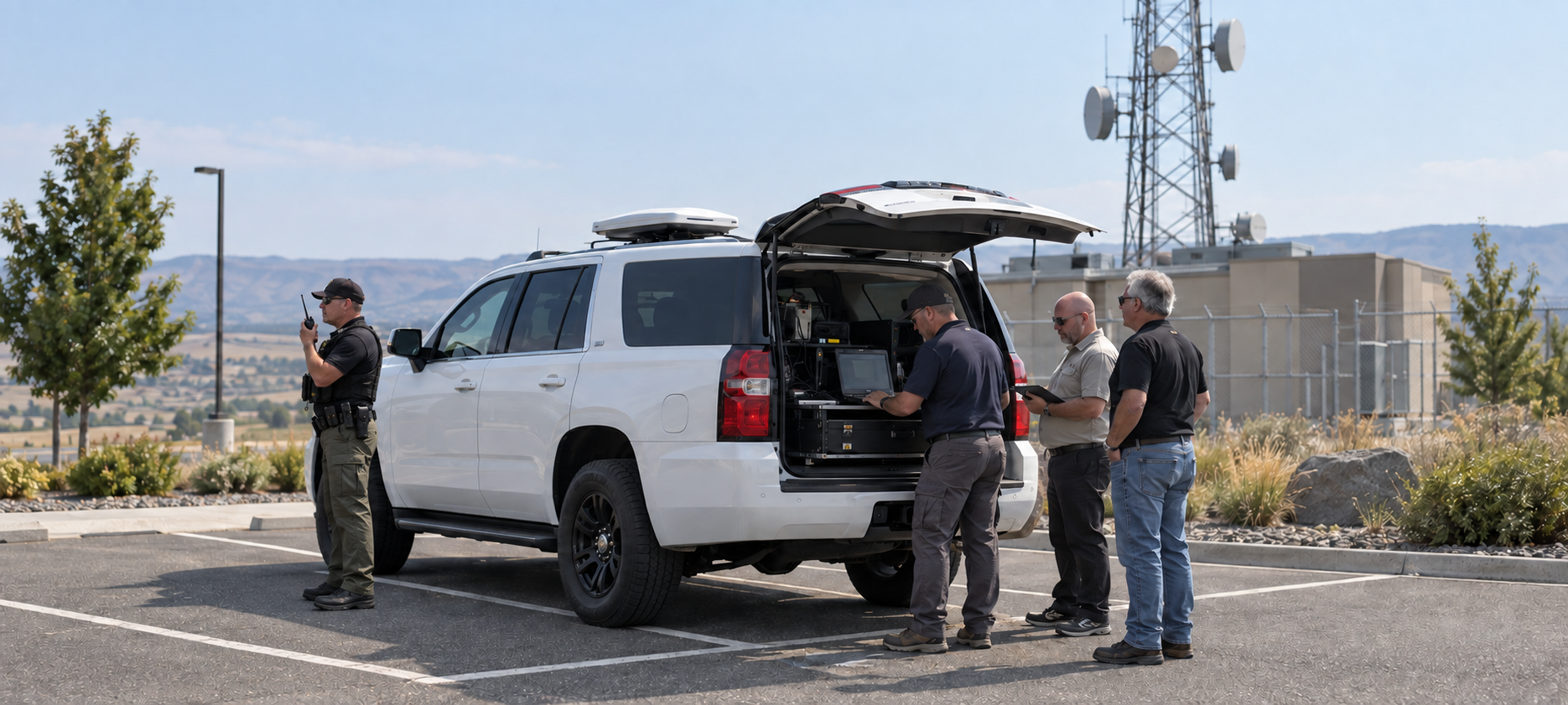
MACC911 Field TestGrant County, Washington
More Than 60 ParticipantsPublic safety, technical, and industry professionals
Four Radio SystemsConnected across three states
The Question It Raised
If a temporary field setup can connect disparate radio systems and continue carrying live traffic as network paths disappear, what should agencies evaluate before spending millions on traditional infrastructure?
This is not an argument for taking radios away.
Land mobile radio remains extraordinarily effective for immediate, shared tactical voice. The white paper recommends maintaining LMR where it is strong while treating it as one part of a broader public safety communications network.
The strategic shift is to build a resilient broadband layer alongside existing radio systems—then use that layer to extend voice, connect agencies, support field applications, and carry information that LMR was never designed to handle.
What the Field Test Showed
Interoperability became an architectural question.
The August 2026 exercise tested how quickly different systems could communicate, how blended broadband performed as individual paths were removed, and how a connected vehicle could extend communications beyond traditional coverage.
Two systems with no previous MACC911 connection joined the test environment in approximately 10 to 15 minutes each.
A continuous radio transmission remained connected while Verizon, FirstNet, AT&T, T-Mobile, and Starlink paths were removed one at a time.
A vehicle-based gateway maintained voice communications in a jail area where usable cellular service and access to the trunked LMR system were unavailable.
Portable radios from multiple manufacturers passed traffic through the vehicle gateway and onto the shared talkgroup.
Portable radio communications reached approximately 4.7 miles from the connected vehicle during one wildland range test.
Important context: This was a field demonstration, not a controlled or longitudinal study. The team also observed intermittent audio loss, differences in emergency-button behavior, and gateway configuration restrictions. These open issues are documented in the white paper and should be tested before operational deployment. The 4.7-mile result is not a guaranteed coverage specification; range varies by terrain, antenna placement, frequency, power, obstructions, and RF conditions.
A Network-Centered Model
Keep the radio. Extend the reach.
Moving voice onto IP does not eliminate RF. It gives existing radio traffic a path beyond the footprint of a single radio system.
LMR remains essential
Immediate shared voice, tactical operations, direct and simplex communications, fireground use, and coverage engineered independently of commercial networks remain core strengths of LMR.
Broadband expands what is possible
A resilient IP layer can support radio interoperability, CAD, AVL, video, maps, messaging, remote dispatch, sensor data, location, and applications that agencies have not selected yet.
“The radio system should no longer be the public safety communications network. It should be part of the public safety communications network.”
Where the Next Dollar Goes
Compare capabilities—not just equipment.
Existing LMR systems should be maintained while they perform critical work. The paper asks agencies to stop funding expansion automatically and compare towers, radio upgrades, vehicle broadband, satellite, gateways, HPUE, broadband PTT, and targeted coverage against the same operational requirements.
Sometimes a tower will still be the right choice. The recommendation is that it should have to prove it.
$25M–$50MIllustrative range cited for a full LMR system replacement in the western United States
$2M–$3MIllustrative cost cited for a single new tower site
About $10KMACC911 planning order of magnitude for one well-equipped vehicle connectivity package
Figures are rough planning comparisons reported in the white paper, not universal market prices or project quotes. Configuration, engineering, geography, labor, service, and integration requirements affect actual costs.
The Connected Vehicle
The vehicle becomes part of the communications infrastructure.
A public safety vehicle equipped with resilient broadband and a radio gateway can provide local RF access, carry traffic across multiple terrestrial and satellite paths, and create a connectivity bubble for nearby devices and applications.
Extend radio communicationsBridge local portable radio traffic onto an IP network beyond the normal system footprint.
Support operational dataConnect CAD, AVL, video, maps, messaging, and other field applications.
Diversify network pathsCombine cellular and LEO satellite paths with different infrastructure and failure modes.
Deploy infrastructure where neededBring a managed communications node to incidents, coverage gaps, and mutual-aid operations.
The IP Access Value
The network can be complex. The responder experience should not be.
Technology alone does not create a resilient communications system. The network paths, hardware, applications, and field equipment must be properly selected, integrated, installed, tested, monitored, and supported as one operational environment.
IP Access International provided the systems integration and managed connectivity supporting MACC911’s blended architecture. The field-test environment brought together cellular paths across AT&T, Verizon, and T-Mobile; FirstNet connectivity with high-power Band 14 equipment; Starlink LEO satellite connectivity; Dejero Smart Blending Technology; vehicle Wi-Fi; radio gateway integration; field services; and ongoing support.
Through SuperGIG™, IP Access manages terrestrial and space-based connectivity as one network. Available paths are continuously evaluated based on real-time performance, helping voice, CAD, AVL, video, and other critical applications continue as network conditions change.
The result is a resilient connectivity foundation that extends the reach of existing radio systems while supporting the applications and information responders increasingly depend on.
Managed terrestrial and LEO satellite connectivity
Quality-based network blending through SuperGIG™
Vehicle connectivity engineering and professional installation
Gateway, radio, and application integration
Real-world performance and path-loss testing
One U.S.-based support team available 24/7/365
What Leaders Can Do Now
Start small. Test honestly. Expand what works.
Evaluate the workflow
Identify the operational problem, what information needs to move, and whether voice, data, or a combination is the best medium.
Test the difficult details
Verify emergency behavior, identity, recording, encryption, console presentation, coverage gaps, cybersecurity, and degraded modes.
Build evidence before scale
Run a controlled proof of concept with responders and dispatchers, measure the results, and let each phase earn the next investment.
Read the Full Research
Download the Broadband First white paper.
Review the complete field-test record, observed limitations, economic framework, phased five-year investment plan, and public safety procurement checklist.