
Starlink for Mobile Command Units
How public safety agencies can integrate Starlink into mobile command vehicles to support CAD, mapping, video, incident coordination and other connected applications in the field.
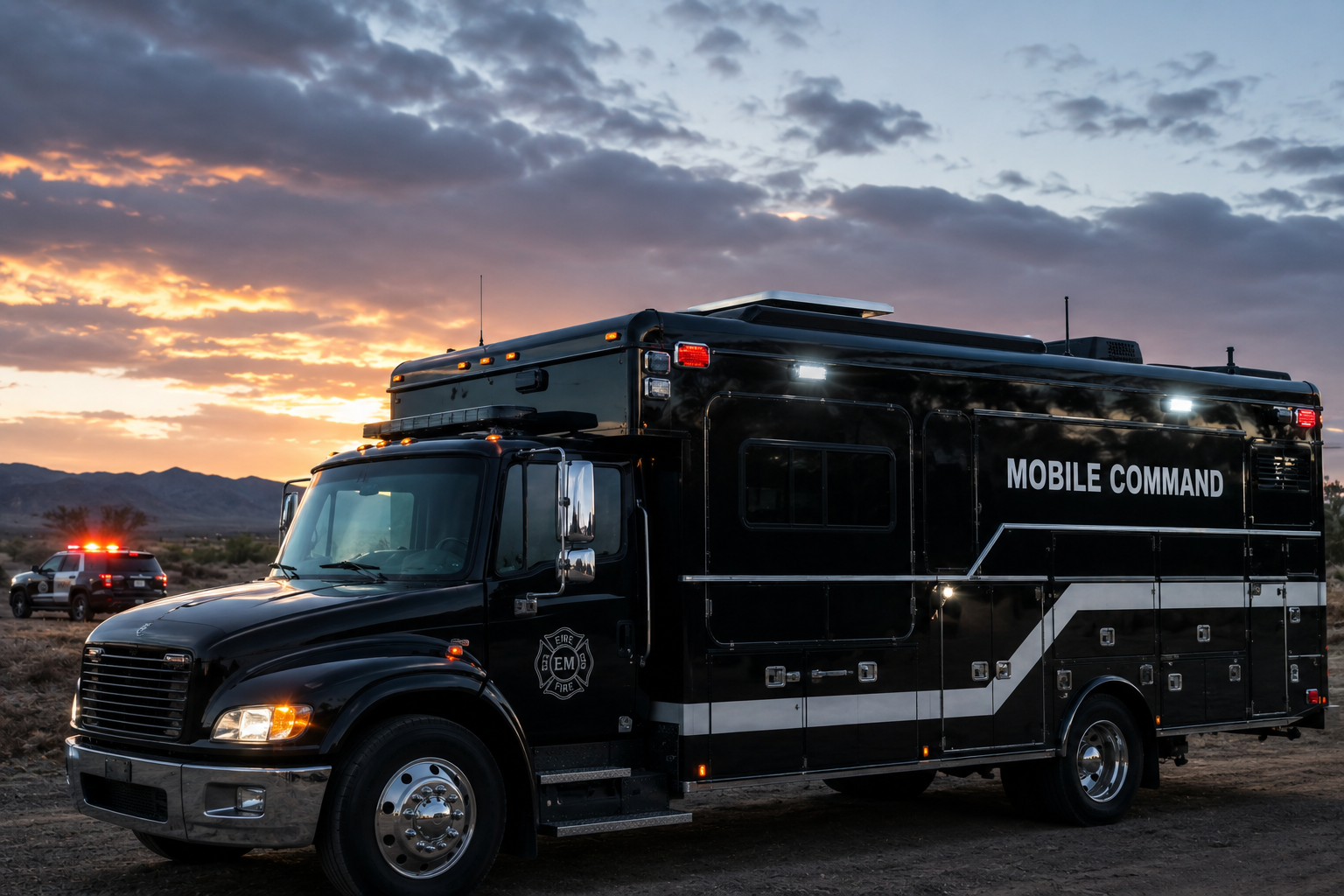
Mobile command units are designed to bring coordination, communications and decision-making closer to the incident. They may deploy to wildfires, large public events, severe weather, search-and-rescue missions, extended law enforcement incidents or other operations where agencies need a temporary command environment in the field.
Inside those vehicles, personnel increasingly rely on connected applications such as CAD, GIS, mapping, situational awareness, cloud platforms, video and incident documentation.
The mobile command unit has to stay connected even when the operating environment changes.
Why Connectivity Matters Inside a Mobile Command Unit
A mobile command vehicle can function like a temporary extension of an emergency operations center.
Personnel inside may be coordinating field teams, reviewing maps, monitoring video, communicating with dispatch, accessing cloud-based applications and supporting decision-makers across multiple agencies.
Those workflows increasingly depend on broadband connectivity.
When the vehicle is parked in an area with strong terrestrial service, connecting those applications may be relatively straightforward. The challenge comes when an incident occurs where cellular performance is limited, infrastructure has been damaged or local networks are under heavy demand.
That is where satellite connectivity can add another valuable network path.
Why Agencies Are Adding Starlink to Command Vehicles
Starlink uses a Low Earth orbit satellite network to provide broadband connectivity in locations with an appropriate view of the sky.
For mobile command units, that can provide another internet path without relying entirely on nearby terrestrial infrastructure.
CAD & Dispatch
Support access to computer-aided dispatch and related agency applications from the field.
GIS & Mapping
Give command personnel access to mapping, incident locations and geographic information systems.
Video & Situational Awareness
Support connected cameras, video platforms and shared situational awareness tools.
Cloud Applications
Maintain access to remote agency systems, messaging, documentation and other IP-based workflows.
For agencies that move command assets across large service areas, the ability to bring a space-based connection with the vehicle can add flexibility.
Learn more about Starlink and explore managed Starlink service from IP Access.
Mobile Command Units Go Where the Incident Goes
Command vehicles are valuable because they are mobile.
That also means the connectivity environment constantly changes.
One deployment may take place in a city with strong cellular coverage. The next may be along a rural highway. Another may be near a wildfire perimeter, evacuation center, staging area or temporary incident command post.
Starlink gives agencies another connectivity option when terrestrial networks are limited, but it should still be viewed as one part of the overall command-vehicle architecture.
Starlink Should Be One Path, Not the Only Path
No communications network performs perfectly everywhere.
Cellular performance changes by carrier, geography, congestion and local infrastructure. Satellite connectivity has its own environmental and deployment requirements.
For mission-critical command operations, the better strategy is often network diversity.
Instead of building the vehicle around a single carrier or satellite connection, agencies can create an environment with access to multiple terrestrial and space-based networks.
IP Access International's SuperGIG™ managed connectivity platform is designed around this approach, bringing selected network paths into one managed environment for critical operations.
Integrating Starlink Into the Command Vehicle
A successful Starlink deployment involves more than choosing a terminal.
The complete installation may require planning around antenna placement, cable routing, onboard power, routers, Wi-Fi, network architecture, environmental exposure and existing communications equipment.
Every mobile command unit is different.
Some are large specialty vehicles with extensive communications racks and roof space. Others may be trailers, vans, SUVs or smaller rapid-response platforms.
The appropriate Starlink hardware and installation approach should fit the actual vehicle, operational requirements and available space.
IP Access provides professional installation and integration services to help agencies incorporate Starlink and other connectivity technologies into existing or newly built mobile command systems.
Creating a Connectivity Bubble Around the Command Unit
The value of a connected command vehicle can extend beyond the personnel sitting inside it.
When properly designed, the vehicle can create a local connectivity environment around the command post.
Authorized responders nearby may be able to connect tablets, laptops, phones and other devices to the vehicle network, giving personnel access to applications and information without requiring every user to maintain a separate satellite connection.
That can be especially useful during incident command, emergency management, mutual-aid operations and temporary field deployments.
Explore mobile connectivity solutions for public safety vehicles and field operations.
Supporting Multiple Applications at the Same Time
Command vehicles rarely use one application at a time.
One person may be reviewing mapping data while another accesses CAD. Video may be transmitting while personnel upload documentation. Other users may be accessing cloud applications or agency resources.
That makes bandwidth and network quality important.
The question is not simply whether the vehicle has internet. It is whether the available connectivity can support the applications that matter most during the incident.
A managed multi-network design can give agencies more options than expecting one broadband connection to support every user and application under every operating condition.
Portable Starlink Can Support Command Operations Too
Not every command environment is a permanently equipped vehicle.
Agencies may establish temporary command posts using trailers, tents, shelters or rapidly deployed communications kits.
Portable Starlink options can give agencies another way to establish connectivity at those locations when nearby terrestrial infrastructure is unavailable or limited.
Portable systems can also serve as supplemental equipment for mobile command units, emergency management teams and mutual-aid deployments.
Power, runtime, service management and ease of deployment should all be considered when building a portable satellite communications kit.
Quick-Deployment Connectivity
Explore portable satellite, cellular and field connectivity options for temporary command posts, emergency operations and rapidly changing deployment environments.
Managing Starlink Across Multiple Command Assets
An agency with one command vehicle may have relatively simple requirements.
An organization with multiple command units, trailers, deployable kits and emergency operations assets has a different management challenge.
- Multiple Starlink terminals
- Service plans
- Data consumption
- Hardware assignments
- Activations
- Installation records
- Troubleshooting
- Network integration
- Ongoing support
IP Access International is an Authorized Starlink Reseller and can provide Starlink hardware, managed service, installation and 24/7/365 U.S.-based network support.
For agencies deploying Starlink across multiple assets, a centralized service model can also simplify administration and ongoing management.
Planning for Data Across a Mobile Command Fleet
Usage on mobile command units can vary significantly.
One vehicle may sit unused for a period and then become heavily utilized during a major incident. Another may support frequent planned events, training exercises or emergency operations.
That makes service and data planning an important part of the deployment.
Depending on the selected plan and fleet structure, managed and pooled data options may provide a more practical way to support multiple Starlink-enabled assets than treating every terminal as a completely isolated subscription.
The objective is to structure service around how the command fleet actually operates.
A Mobile Command Unit Is Part of the Communications Network
The modern mobile command vehicle is more than a place to hold meetings.
It is becoming an active part of the public safety communications environment.
The vehicle can connect applications, personnel, field devices and agency systems while creating a communications presence closer to the incident.
Starlink can play an important role by adding a space-based connectivity path, but the strongest approach is to think beyond the terminal.
Satellite hardware, cellular connectivity, routers, Wi-Fi, installation, service and network support should work together as one operational system.
Mission-Critical Connectivity for Public Safety
Explore the broader role of cellular, LEO satellite, connected vehicles, rapid deployment and managed multi-network connectivity in modern public safety operations.
From Starlink Hardware to a Connected Command Environment
Installing Starlink on a mobile command unit can give an agency another valuable way to reach the applications and information it depends on.
But the terminal itself is only one part of the solution.
The stronger question is how satellite, cellular, onboard networking, applications, data management, installation and support can work together around the mission.
IP Access International helps public safety and emergency management agencies design, install and manage Starlink and multi-network connectivity for mobile command units, emergency vehicles, trailers and rapid-response deployments.
Planning Connectivity for a Mobile Command Unit?
Every command vehicle is different. IP Access can help evaluate Starlink hardware, cellular connectivity, vehicle installation, network architecture, service and ongoing support around the applications your team needs in the field.
Common Questions About Starlink on Mobile Command Units
Answers to common questions public safety agencies may have when evaluating Starlink for mobile command and incident response vehicles.
Can Starlink be used on a mobile command unit?
Yes. Compatible Starlink hardware can be incorporated into mobile command vehicles as part of the vehicle's broader internet and networking architecture.
What can a mobile command unit use Starlink for?
Starlink can support IP-based applications such as CAD, mapping, GIS, video, situational awareness, messaging, cloud applications and remote access to agency systems.
Should Starlink be the only internet connection on a command vehicle?
For mission-critical operations, agencies may benefit from combining satellite with available terrestrial networks so the vehicle has more than one potential connectivity path.
Can Starlink and cellular work together on a mobile command vehicle?
Yes. Starlink and cellular networks can be incorporated into the same vehicle connectivity architecture, giving agencies access to terrestrial and space-based network options.
Can a command vehicle provide Wi-Fi to personnel nearby?
Yes. A properly designed onboard network can create a local Wi-Fi environment around the command unit for authorized personnel and connected devices.
Does IP Access install Starlink on public safety vehicles?
IP Access provides professional installation and integration for Starlink and multi-network connectivity deployments on public safety and emergency response vehicles.